
Great New Review of That Which Should Not Be by Douglas Wynne!
 If you’ve read his stuff, you know that Douglas Wynn is one of the best new voices in the horror genre. His debut, The Devil of Echo Lake, is truly one of the best novels I have read. And his latest work, Steel Breeze, is getting rave reviews. Seriously, if you read it and don’t like it, congratulations. You might very well be the first. Just read the reviews if you don’t believe me. And that’s why I was so pleased to see the review below that Doug left of That Which Should Not Be. It means a lot to me, and hopefully it means a lot to you, too. So guy buy his books–and mine while you are at it–and get ready for some fantastic scares.
The Standard by Which New Mythos Fiction is Measured, July 30, 2013It’s easy to see why That Which Should Not Be has become a benchmark for new Lovecraftian fiction. Brett J. Talley really hit a home run with his first novel, which is actually a series of interconnected tales surrounding two dread tomes and the legendary Miskatonic University. Many writers have taken on the Lovecraft mythos, but I think what sets Talley apart is that he knows it’s not enough to merely name check mythos gods, or toss some tentacles into the stew without delivering the cosmic dread that characterizes the best work in the genre. Neither does he try to cop Lovecraft’s unique writing style. TWSNB is told with a voice of its own, in a gothic style that suits the subject. And that insanity inducing sense of cosmic dread? It’s here in spades.
Filed under Uncategorized
Review of the Conjuring–4.5 Stars
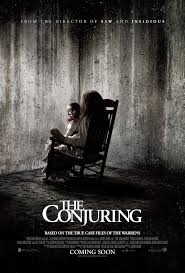 Let’s cut to the chase—see this movie, and see it now.
The Conjuring is a story from the case files of Ed and Lorraine Warren, two of the most famous paranormal investigators in the world. It follows the family of Carolyn and Roger Parren as they endure a frightening and malevolent spirit that is threatening not only their sanity, but their very lives.
The Conjuring is a scary movie, and it accomplishes that in the old way. It reminded me of The Haunting in that it builds the tension and suspense slowly, relying on sounds in the dark and movement in the shadows for its scares. And when the ghouls do appear, it’s absolutely terrifying. The jump scares are limited so as not to lose their power, and they are effective when deployed. The Conjuring is intense, and even if it loses some of its steam during the denouement, it will scare you.
4.5 Stars
Filed under Uncategorized
The Mind Blowing Truth About The Terminator Series
News broke last month that Paramount is rebooting the Terminator franchise—to the tune of an entire new trilogy. There’s even talk of Arnold returning to his role as the T-800, though one wonders why the machines would pattern the terminator after an old man. Infiltrating old folks homes, perhaps?
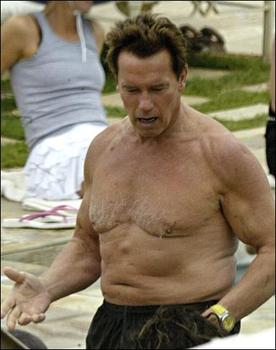
I’ll be back…after my nap.
But the bigger question I have for Paramount is whether they will address the central paradox at the heart of the Terminator series, one so mind-blowingly brilliant that I wonder if anyone involved with the series actually meant for it to happen. Or if, like a young Arnold’s rippling muscles, it just came about naturally.
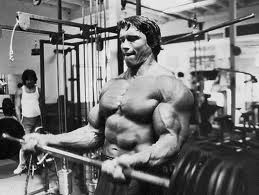
The glory days.
What paradox is that, you ask? Well, it starts with the fact that . . .
1. John Connor wouldn’t exist if the Machines had never sent back the Terminator in the first place.
Others have made similar points before, but they’ve never taken it to the logical conclusion I’ll get to later. For those of you who somehow missed out on a decade of pop culture (and, uh, spoilers?), in the original Terminator, the governor of California travels back in time in the form of a murderous cyborg, intent on killing John Connor, the leader of the future resistance against our machine overlords, known as Skynet. Being clever, the robots choose to kill Sarah Connor before John is even a twinkle in her eye. It’s the grandfather paradox put to good use. Kill the mother, and the son never exists. Their efforts are futile, however, as our wily Resistance sends Kyle Reese back to warn Sarah, save her life, and ensure that John is born to fight a first day. And ensure it he does, sleeping with Sarah, and impregnating here with the future commander-in-chief of the human forces.

Above and beyond the call of duty…
Already, a weird little paradox is popping up. Let’s review the timeline before the terminator is sent back in time. Sarah Connor was born and lived. Then she had a kid named John. Then Skynet became sentient, nuked the world, and John Connor rose to lead the Resistance. He smashed Skynet’s defense network, and in one last desperate attempt to survive, Skynet sent back a terminator to kill John Connor’s mother. But wait. How does John Connor even exist in the first place in this timeline?
Here’s the thing, most time travel stories involve a guy who already exists going back in time and messing something up. If there is a paradox, it’s that the guy who exists goes back in time and does something so that he doesn’t exist, thus meaning he never went back in time, thus meaning he does exist, in which case he goes back in time…you get the picture. But this is different. In this case, John Connor never exists in the first place to defeat Skynet until he defeats Skynet and inspires them to send his father back in time so he can exist. Which is weird.

But it gets weirder.
2. Skynet wouldn’t exist if Skynet had never sent back the Terminator in the first place.
In Terminator 2, Skynet takes another shot at John Connor, this time when he is a sniveling ten-year-old (Seriously, did anyone realize that Edward Furlong was supposed to be playing a kid barely in the double digits? He was 14 when Terminator 2 debuted in 1991, and he looks it, too).
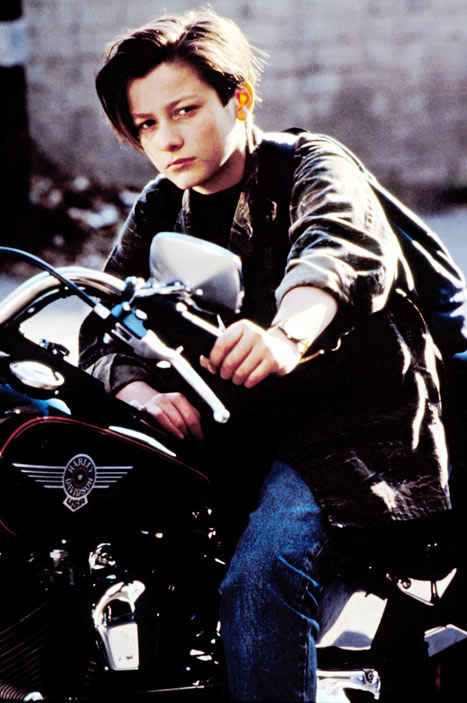
Pictured Here: Hollywood’s idea of a ten-year-old.
But wait, there’s a twist! Come to find out, Skynet only exists because the remains of the first terminator were discovered by Cyberdyne, who then reverse engineered the technology in order to design the computer program that eventually nukes the world. Basically, Skynet’s daddy is the terminator from the first movie. And, following the same time-travel paradox arc as John Connor, Skynet only comes into being because it sent the terminator back in the first place.
Both Terminator and Terminator 2 can be viewed in a completely different light when you start thinking about all this fatherhood stuff. The movies are like Mama Mia without Abba, the dancing, or Pierce Brosnan’s terrible singing.
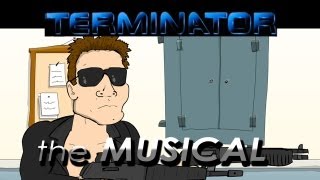
And because the internet has thought of everything…
Terminator 3 manages to twist this pretzel even tighter.
3. After Rise of the Machines, Skynet knows that it is responsible for John Connor’s birth.
In the first two Terminators, Skynet tries—and fails—to mess with the timeline. But in Rise of the Machines, there’s a whole lot of messing going on. Think about it. In the first Terminator, all Skynet knew was that John Connor was the leader of the Resistance and that Sarah Connor was his mother. The same knowledge applies for Terminator 2. But then something changed in Terminator 3. The T-X was sent back not only to kill John Connor, but also to help facilitate the rise of the machines and Skynet’s conquest of the globe. In doing so, she imparted knowledge to Skynet about the past and the future. By the time we get to Terminator: Salvation, Skynet knows that Kyle Reese is John Connor’s father. It knows that he goes back in time to stop their first effort to kill Connor. And what would Skynet do with this knowledge?
4. Skynet must decide not to send back the terminator to kill John Connor.
Skynet is not stupid. In fact, it is very smart. And, as we learn in Salvation, it is capable of radical thinking. Here’s a radical thought for it. In order to kill John Connor, Skynet needs to decide not to kill John Connor.
All Skynet has to do to stop John Connor from being born is to never send a terminator back to kill him in the first place. In that case, there’d be no reason for Reese to go back, and even if he did, no reason for Sarah Connor to fall in love with him. Reese would just be a crazy stalker raving about saving the future by getting into Sarah Connor’s pants. It’s a creative pickup line, but one that’s unlikely to work. And because he would fail, John Connor is never born, and Skynet never loses the war.
Now, you might think there’s a problem for everyone’s favorite self-aware killing machine. If John Connor is never born, then Skynet never exists, because Cyberdyne never discovers the remains of the first terminator, and it never develops the software that gives Skynet sentience. But that’s not quite true. We know that Cyberdyne used the technology to make advances in the company’s thinking on cybernetics, but that doesn’t mean that it never would have made those leaps without a little help. And besides, Skynet can always send an arm back in time and drop it in Miles Dyson’s lap. Then Skynet exists, John Connor doesn’t, and Skynet wins. Right?
Actually, not at all. Remember that first paradox? The one about John Connor never existing unless John Connor sends Kyle Reese back to father him? There’s really only one way for that to work, and once you understand it, you see the secret brilliance of the entire Terminator series.
5. Kyle Reese isn’t John Connor’s father at all.
Forget everything the movies teach you after the first five minutes or so of the first Terminator. What do we know happened before there was any time-travel, before anyone went back in time to kill or save another person? We know that someone named John Connor existed. And we know that the real John Connor, the one that defeated the machines and caused them to send back the T-800 to kill him, was not the son of Kyle Reese. He was fathered by a completely different man, a man that Sarah Connor met at a point in her life when she did not know there would be a Judgment Day, a man who helped to mold John Connor into the warrior he would become.
And that means that Kyle Reese, by intercepting and impregnating Sarah Connor before she could meet this man, did the one thing that Skynet never could do.
He killed John Connor.
Oh sure, Sarah got pregnant and she named her son John, just as the person from the future told her she should do. But that’s where the similarities between the two men she calls her children end. The new John Connor lives off of his alternate self’s accomplishments. He believes that he is supposed to lead the Resistance because the real John Connor did. People believe in him because of what a man who never came to exist accomplished in an alternate timeline. That’s why John Connor in Terminator 3 has such doubts about his ability to fulfill his destiny. He can’t, because he isn’t John Connor. And that means . . .
6. By doing the most logical thing and not sending back the terminator to kill John Connor, Skynet is destroying itself.
Crazy, right?
Skynet is holding a gun to its own head, and it doesn’t even know it. In the wake of Terminator: Salvation, Skynet will do the only thing that makes sense. It won’t send back a terminator to kill John Connor. By making this decision, Skynet ensures that Kyle Reese will never go back in time, either. And that means that John Connor will be born in the situation he should be born in, and that the real Connor will rise to lead the Resistance and defeat Skynet.
That is how the Terminator saga ends, my friends, with Skynet doing the one thing that will lead to its own destruction—not trying to kill John Connor.
Now you might ask, does that mean that Skynet’s decision to not attempt a preemptive murder would end up restoring the original timeline and starting the whole chain of events all over again, creating an endless loop, an eternal struggle that keeps repeating forever?
Possibly. Perhaps that is how the world ends, with Skynet locked in a paradox. But it is also possible that Skynet is simply creating new timelines in the multiverse. And in each one, Skynet is destroyed. It would seem that in the Terminator universe, not only is judgment day inevitable, but so too is the victory of the human race.

Come with me if you want to live.
Sign up for my email list! I promise not to spam you, and I’ll never give away your information. This is only for BIG announcements like new book releases or Pulitzer prizes won. That sort of thing. Click here to sign up!
Filed under Uncategorized
Free Music Friday: Boston and St Johns by Great Big Sea
A tribute to my second home. Washington, D.C. just doesn’t have anything on Boston or Alabama.
Filed under Uncategorized
Need Your Help To Get To 100 Reviews on Amazon
There’s something about having 100 reviews on Amazon. Since most people don’t leave reviews after they finish a read, most indie books never get even close to 100 reviews. Right now, That Which Should Not Be sits at 87. So I need your help. If you’ve read the book, take a few minutes to give it a review over at Amazon. It only takes 13 of you, and every one of your reviews is precious. Thanks guys!
Filed under Uncategorized
My Thoughts on the new Prince George
All in good fun of course. Congrats to my British friends on their new master.
Filed under Uncategorized
That Which Should Not Be Group Read Continues on Horror Aficionados
Having a great discussion over at Horror Aficionados on Goodreads. Already had some tremendous posts and back and forth with folks who are reading the book. Would love to have some of you join us! Click here for the discussion.
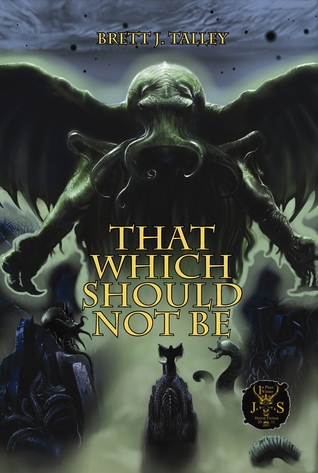
That Which Should Not Be
Filed under Uncategorized

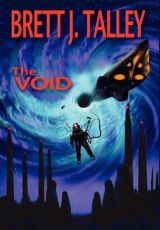
Horror Aficionados is Having A Buddy Read Featuring The Void
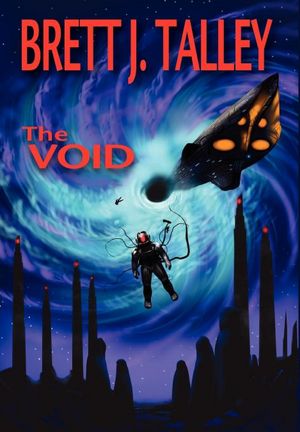
The Void
That Which Should Not Be gets all the Lovecraftian love, but The Void is a darn good book in its own right. Find out by joining a buddy read that’s about to start in the Goodreads group of Horror Aficionados. I’ll be there answering questions about the book, so join us! Click here.
Filed under Uncategorized
It’s Finally Ironic by Rachael Hurwitz (A Take On Alanis Morissette’s “Ironic”)
This clever revision of Alanis Morissette’s “Ironic” attempts to create a song that, the songstress purports, is actually ironic. I enjoyed it quite a bit, even if it is the result of the widely held belief that Morissette’s song ironically does not contain any examples of irony. In my life, I have found that sticklers for grammar and the proper use of the English language often have no idea what they are talking about. No, Morissette’s song is not ironic in the classical sense of the word (nor, for that matter, is most of what we consider ironic). But I would argue that they do demonstrate “an incongruity between what might be expected and what actually occurs.” Dying on your first flight–the safest form of travel–after a lifetime of avoiding it? I call ironic. Anyway, enjoy the song.
Filed under Uncategorized
My Journey To Centralia, The American Ghost Town That Inspired The Silent Hill Franchise

It turns out that my posts about strange places I have visited are far more popular than posts about my misbegotten novels, so I’ve decided to give people what they want. Following in the footsteps of the post about my trip to Prypiat/Chernobyl and Cesky Krumlov, here is a chronicle of my trip to Centralia, Pennsylvania.
It’s a place you probably haven’t heard of before, but the curse that fell upon this now abandoned town is the story that inspired the creators of the Silent Hill series of video games* and movies. Want to know what happened? The story is told below, through the captions in these pictures. Like Chernobyl, the story of Centralia is one we all know–it is the story of the folly of man. Click on the pictures below to embiggen them and get the full story.
*Turns out that it only inspired the movie.
-

- If a visitor to central Pennsylvania should depart from the well-traveled path of the interstate and find himself on Highway 61, he will come upon a place where the road turns sharply right for no apparent reason or purpose.
-

- Most people simply drive on, but if you stop and climb over the earthen berm, you will find yourself on the road to Centralia.
-

- This was the mining town of Centralia in the 1970s.
-

- This is Centralia today.
-

- Centralia, like most places in central Pennsylvania, was built on coal. For years, the city grew wealthy and the coal flowed.
-

- But then a fire started in one of the mines. No one knows how or who. The town fathers could have extinguished that fire for a mere $50,000.
-

- But even though they were siting on nearly a billion dollars of black gold, they decided not to pay. Instead they buried the fire and the problem. And for decades, all seemed well.
-

- But the fire did not die. Instead it grew, burning through the coal seams. Growing hotter and bigger as it went. Then the rats came.
-

- They covered the town in a rodent wave. But no sooner had the pestilence arrived than it died away.
-

- It wasn’t until a gas station attendant recorded a temperature of 180 degrees in his underground tank that it all became clear. The fire that the town had buried all those years ago had returned. In fact, it had never gone away.
-

- Highway 61 went first.
-

- Some places the road melted.
-

- Other places it simply cracked from the heat.
-

- One could never know whether the road might sink beneath them.
-

- Or whether it would buckle and rise from the roaring heat below. When a 150 foot deep sinkhole almost swallowed a boy in his back yard, the town’s fate was sealed.
-

- Some houses burned.
-

- Others sank into the earth. Most were simply bulldozed when eminent domain was exercised by the state.
-

- The people of Centralia were mostly Eastern European.
-

- This Orthodox church they built still watches over the town. It was the model for the church seen in the Silent Hill films.
-

- They buried their dead here, and the cemetery remains well kept.
-

- But the gesture is an empty one. Most of the experts who study this area agree that the graves beneath these monuments have subsumed, the bodies plunging to the fiery abyss below.
-

- The fire still burns.
-

- It has moved from the area beneath what is now known as Destroyed Highway 61.
-

- But it has not fled far from the surface.
-

- It burns on, and nothing can grow where the heat is at its worst.
-

- On cold days, the smoke is so thick that you can’t see your feet.
-

- But even on a hot summer day, the evidence of the fire is everywhere.
-

- The ground itself burns, and the heat can be unbearable.
-

- Some spots have been known to have recorded temperatures of in excess of 500 degrees.
-

- One must be constantly on the lookout for uneven earth or spots where the ground may collapse.
-

- Evidence of the town’s efforts to fight the fire remains. Here is a metal pipe used to vent poisonous gases.
-

- These efforts were in vain, of course, and did nothing but provide fresh air for the fire.
-

- A handful of Centralia’s residents still refuse to leave, despite the state’s best efforts.
-

- The town has lost its zip code, and the streets themselves have disappeared from the maps.
-

- Poisonous gases fill the lowlands, and visitation is discouraged.
-

- The municipal building, where the decision that damned the town was made all those years ago, is one of the few buildings that still stands.
-

- Traces of the city remain.
-

- But only traces.
-

- The town’s desolation is complete.
-

- Centralia is a city out of time, a place where the past and present collide.
-

- Ironic, eh?
-

- And so we left Centralia behind. But the fire lives. It will burn for another 1000 years.
-

- The mysterious photographer…
Filed under Uncategorized
World War Z Review–3.5 Stars

In 2003, The Zombie Survival Guide hit the market to little fanfare. But because of strong word of mouth and the hard work of author Max Brooks, the book soon became a cult hit and then a sensation. When World War Z was published in 2006, it was an instant bestseller, and speculation immediately began on when the book would become a film, with a bidding war breaking out over the rights between Leonardo DiCaprio’s production company Appian Way and Brad Pitt’s Plan B Entertainment. Brad Pitt won.
And then . . . nothing. For years, the production languished. Costs bloomed. Rewrites were rewritten. Many speculated that Pitt might have a bomb on his hands. Instead, World War Z has been largely a success, with box office totals north of $300 million as of this writing. But the questions remains, is the movie any good?
Yeah, it’s not bad actually.
First, if you are going to enjoy this movie you need to forget about the book. There are homages to it here or there, but for the most part this is a different film that, at best, happens in the universe of Max Brooks’s work. The zombies are more akin to the infected in 28 Days Later than they are the walking undead of Romero.
Brad Pitt plays Gerry Lane, a former UN investigator who now spends his days flipping pancakes instead of on the front lines of the world’s conflicts. But when he and his family find themselves in the middle of the zombie outbreak in downtown Philadelphia, Gerry agrees to go back into the field in exchange for his family’s safety. His search for a cure to the zombie plague takes him from Korea to Israel to Wales, with zombie attacks galore in between.
World War Z is a pretty good movie, but it has some flaws. First, it’s PG 13. Violence isn’t everything, but when you have a movie that is about the zombie apocalypse, having most things happen off-screen just takes something away from the proceedings. Worse, the movie feels like it would have been better as a miniseries. The set pieces are disjointed and poorly connected. It’s almost as if we are going around the world just cause. These scenes need more fleshing out. And yet, the movie also seems overlong. If it were twenty minutes shorter, the movie would have been stronger, in my view.
But I’m being overly negative. If you like zombies, you will enjoy World War Z. It’s not destined to be one of the great zombie movies in my opinion, but it is more than adequate for a summer blockbuster, and hopefully its excellent box office will encourage more zombie movies in the future.
3.5 Stars
Filed under Uncategorized


 Beware The Shadows