In the conclusion to our review of Dreams in the Witch House, the rock opera reaches its conclusion. Darkness falls, and the fight for Gilman’s soul rages on.
11. Blessed are the Faithful
Gilman’s friends unite to conduct an intervention with Gilman on the eve of Walpurgis Night. They urge him to put his faith in God, even as a child has been abducted from town. Meanwhile, chants float down from Meadows Hill…
4 stars
12. Crawling Chaos
But the forces of evil aligned against Gilman are too strong. The nameless cults shout his name, and Nyarlathotep answers them.
5 stars
13. Azathoth
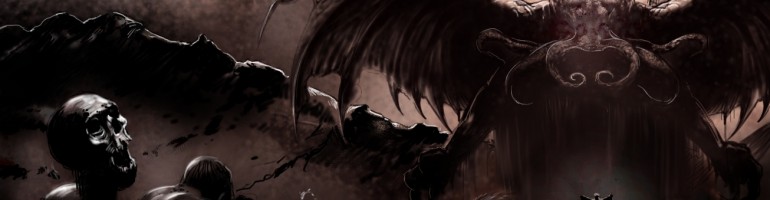
Now Gilman comes face to face with the mad chaos at the heart of all things, the blind idiot god, Azathoth. This is the ultimate conclusion of Gilman’s research—the opening of the way to an ancient evil that lurks beyond all space and time.
4 stars
14. The Sacrifice/No Turning Back reprise
Our story reaches its climax as the moon rises on Walpurgis Night. Now Gilman must decide with whom he stands—the dark forces that he has unleashed or the world of light that he has left behind. Will he fight, or will he give in?
5 stars
15. Between Reality and Dreaming
At the heart of Lovecraftian horror, in my view, is that hope comes with a price. Victories may be won, but only at great cost. So too with Gilman.
5 stars
16. Madness is my Destiny
At the end of all things, Gilman wonders the lost worlds. So his tragedy concludes.
As Dreams in the Witch House continues, Gilman is falling further under Keziah’s spell. Will he turn back in time?
6. No Turning Back
Nope. In one of the great songs on the album, Keziah arrives in her full glory. A combination of sultry and foreboding, Keziah draws Gilman further down the path of forbidden knowledge. Representing the seduction of forbidden knowledge, Keziah is a siren leading Gilman to his own destruction.
5 stars
7. Signum Crucis
As Gilman falls under Keziah’s spell, the devout people who live in the house with him take action. For they have seen the violet light underneath his door, the same light that sages throughout time have recognized as a sign of the satanic. Replete with heavy metal riffs, “Signum Crucis” introduces us to the witch’s familiar, Brown Jenkin.
4.5 stars
8. Nothing I Can Do
Gilman finds himself wondering the deserted streets of an ungodly city, not knowing whether his soul is forever lost. A ballad of despair, Kaziah comes to comfort Gilman, to help him see the inevitability of his fate.
4.5 stars
9. Legends and Lore
Of all the songs on the album, this one is my favorite. Imbuing Keziah with far more humanity than Lovecraft could ever have imagined, “Legends and Lore” is a testament to the genius of the HPHLS.
5 stars
10. The Sleepwalker
Gilman falls further and further under the spell of Keziah, finding himself walking down the rain-streaked streets of Arkham.
If there’s one thing fans of Lovecraft love more than his work, it’s criticizing that work, and “The Dreams in the Witch House” has had its fair share. From August Derleth to S.T. Joshi, Lovecraftians have heaped scorn upon the novella. De gustibus non est disputandum andall that jazz, but I find these attacks to be baseless, founded more in critics’ own views of what Lovecraft should be than what he sometimes is. Just as Joshi criticizes another Lovecraftian masterpiece, The Dunwich Horror, as an “aesthetic mistake” that presents a “stock good-verses-evil scenario,” there are some in the horror community who reject the good and evil paradigm altogether in Lovecraftian fiction, particularly when the good guys win.
“The Dreams in the Witch House” not only presents a struggle between good and evil, it contains elements that truly terrify some Lovecraftians—Judeo-Christian concepts. It also has some of the best characters in Lovecraft’s fiction—Brown Jenkin, Keziah Mason, and Walter Gilman. We have call-backs to the Salem witch trials, Cotton Mather, and Judge John Hathorne, Walpurgis Night playing a central role, the appearance of the Necronomicon, Book of Eibon, Unaussprechlichen Kulten, Nyarlathotep, Azathoth, and a cutting-edge mathematical explanation for magic and the realms of the Old Ones.
That’s a lot to recommend it, and perhaps it’s no surprise that two of my favorite interpretations of Lovecraft’s work came from this story—the Master of Horrorepisode directed by Stuart Gordon and the unparalleled H.P. Lovecraft Historical Society’s production of Dreams in the Witch House: A Lovecraftian Rock Opera. Both are great, but the rock opera is brilliant. The HPLHS cut no corners here. Brian Sammons, horror critic and author, laid it out best:
First off, the HPLHS got some talented ringers to back them up on this massive, musical Mythos odyssey. The opera has 16 tracks that feature over 17 singers, including Jody Ashworth (The Trans Siberian Orchestra, which was original formed by members of the aforementioned Savatage), Alaine Kashian (Broadway’s Cats) and Swedish metal phenom Chris Laney as the wonderfully wicked Brown Jenkin. That not enough musical street cred for you? Well, how about this, the album features 14 musicians, including Bruce Kulick (former KISS guitarist) and Douglas Blair Lucek (guitarist for W.A.S.P.). Yes, this album has links to both Savatage and W.A.S.P. Oh, you know I was a happy metalhead to learn that.
So yeah, this is not just your brother throwing something together in his backyard. Over the next three days, we’ll walk through this masterpiece, song by song. Enjoy, and let me know what you think in the comments.
1.The Confession/Arkham Overture
Our adventure begins with Frank Elwood taking confession with Father Inwanicki, setting up that our story will be told in the form of flashbacks. The intro establishes the overall feel for rest of the production, casting Arkham as a place of darkness and mounting dread, while introducing us to some musical riffs that will repeat themselves throughout.
2. Dreams in the Witch House
The first real track is an ensemble blitz laying out the nature of the witch house and the contours of the story. Frank Elwood leads off, followed by the introduction of Walter Gilman himself. A chorus of characters serenades us, and then, like a canon shot, Alaine Kashian makes her first appearance as Keziah Mason, and you know you’ve got something special on your hands.
3. Higher Fire: Breaking Me Down
We learn a little bit more about Gilman and how committed he is to the study of mathematics and the other dimensions that may surround us. Contrast that with Joseph Mazurewicz, who is equally committed to opposing the forces of evil he sees gathering in anticipation of Walpurgis Night. Gilman thinks that Mazurewicz is little more than an annoyance, part of the endless cacophony that is slowly driving him insane. But Gilman is starting to see that the very walls that surround him may hold the key to his studies into the strange geometries that make up the world.
4. Bridge to The Stars
Gilman lays out the cosmic theory he is pursuing, as he attempts to find a way to pass between this dimension to the next. His professor and classmates are initially skeptical, but as Gilman lays out the theory, they start to believe. The chorus that follows reminds me of something out of Rent.
4 stars
5. The Nightmare
Even as Gilman’s theory comes closer to reality, the pressure of his work has begun to invade his dreams. In those nightmares, he walks the path of ancient lost cities of impossible geometries and sees unspeakable things. Gilman the scientist finds himself turning to his faith to protect him from the madness around him. As he calls upon his Lord, a new voice enters, that of Kaziah Mason.
Every Friday this month, I’ll be posting songs from the dark side. We’ll kick it off with a song I include every year during this event: “Dixie Drug Store.” Enjoy, and then enjoy a more classic telling of the story of Marie Laveau–with a New Orleans jazz flavor.
Few genres call for the audience to suspend its disbelief more often than horror. Some of this is understandable–we’re dealing with the supernatural, after all. But some of them are just lazy, and they happen so often that they’ve become standard fare in horror parody’s. The car that won’t start, the heroine who runs up the stairs instead of out the front door, the amorous couple who insists on getting frisky in the abandoned field/house/road/cemetery/amusement park/slaughterhouse…you get the picture.
Here are three of my personal horror pet peeves. Let me know yours in the comments.
The people who refuse to react properly to a paranormal event.
This one happens all the time. Something really crazy weird happens, the scene or chapter ends, and then the next chapter opens with the characters just going on about their business. Maybe they mention it in passing, maybe they talk about that really weird thing that happened, but they never react the way normal people would. Take any haunted house movie. How many of you would stay after even one of the creepy things in Insidiousor Sinisteror The Conjuring? Some ghost lures me into the basement and claps next to my head, I’m out, and I don’t care if I have to declare bankruptcy and live in my parents’ house for the rest of my life. A close corollary to this is the people who don’t call the police when they obviously should.
2. The people in a zombie movie that don’t kill every zombie they see.
You’re living in a zombie infested wasteland. There’s not going to be a cure, but you’ve got a pretty good setup in the local prison. But for some reason, you don’t kill the zombies gathered at the fence. You don’t kill the random zombies you see wondering down the roads when you go out on a run. You just leave them. Cause…why? This thing ain’t ending. So why not kill every single zombie you see? It might take a while, but eventually you and your group are going to at least thin out the herd a little bit. And hey, every zombie you kill is one less zombie that might kill you. So get to killing zombies. If we can wipe out the wolf and the buffalo, we can wipe out the undead.
3. The people who never listen to their significant others.
Don’t know why, but this one I especially hate. I read a book once where a husband and wife moved into a haunted house. Each chapter was told from one of their perspectives. Crazy things were happening to both of them. They didn’t tell each other at first (which also annoys me), but worse than that, when one would open up about some strange thing that was happening, the other would act like they must be going crazy. This happened again and again and again until finally I got so sick of it I stopped reading. You can make this trope work–if it’s only one of them hearing noises or seeing ghosts and that one happened to have had some mental breakdown in the past. But otherwise, spare me.
A few months ago, I was on a flight to Salt Lake City from Atlanta, GA. Normally I read on the plane, but this was a long one, so I decided to watch a movie instead.
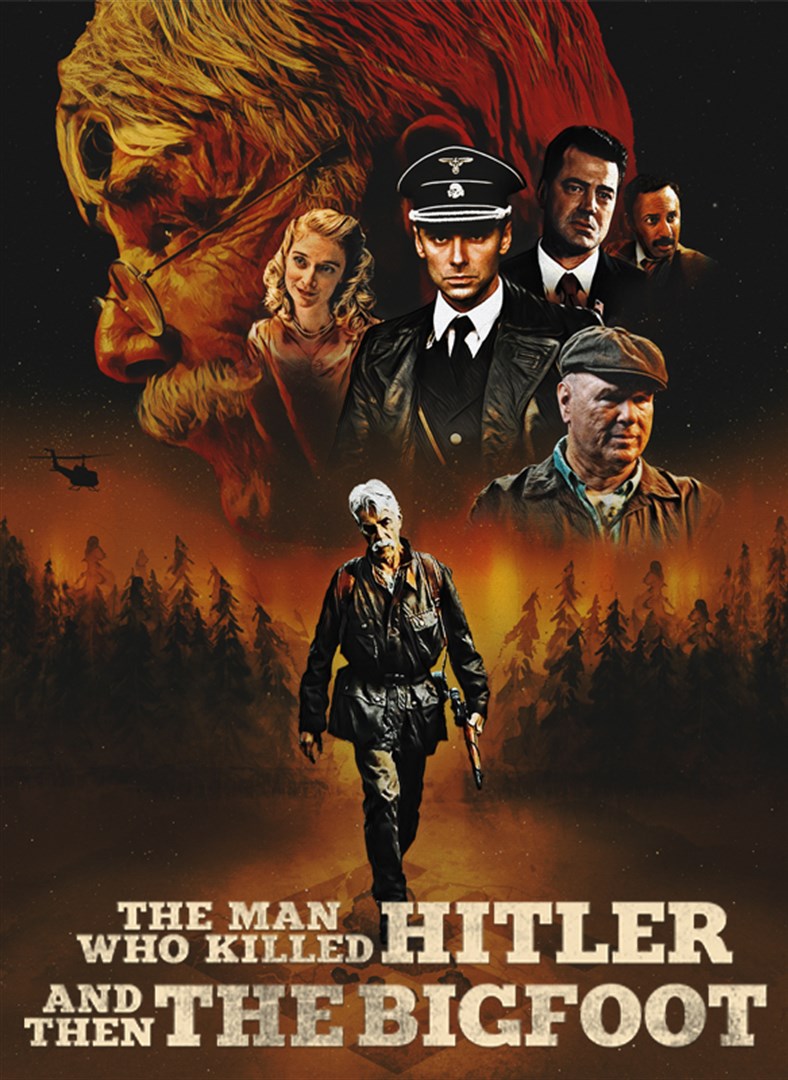
You know how sometimes you’re scrolling through a list of titles and you see one that that catches your eye in such a way where you just have to watch it? Well let me tell you–when you see a movie entitled The Man Who Killed Hitler and Then the Bigfoot, you will stop. I guarantee it. And when I saw it starred Sam Elliott as the eponymous man, well, I was hooked.
Yes, it’s real.
So there aren’t a lot of surprises in the plot of The Man Who Killed Hitler and then the Bigfoot. Before the film ends, Sam Elliott’s character will kill Hitler. And then the Bigfoot. But this movie isn’t going to go the way you think. It’s not a farce or a clever send up of horror. It takes itself very seriously, and there are only a couple of scenes where the filmmakers tongue is planted firmly in cheek (the swastika hands on a wrist watch springs to mind).
Otherwise, the movie plays it straight, presenting a serious story of a highly trained military asset, sent into deep enemy territory to kill Hitler, only to be called back into action decades later when the Bigfoot needs too be taken down as well. There’s a story of love lost, of brothers estranged and reconnected, of a life of regret and the creeping desire to end one’s own life. In fact, the movie plays better as a drama than it does anything else. There were times when I almost had tears in my eyes.
Seriously. In a movie called The Man Who Killed Hitler and then the Bigfoot.
I’m . . . conflicted. On the one hand, I actually liked this movie. It was slow at times, and overlong, but it had some real highlights. The weird aside where the creepy Russian dude shaves the beard of a younger version of Sam Elliott’s character? Great. The execution of the plot to kill Hitler? Excellent. And the movie is, frankly, star-studded. In addition to Sam Elliott, there’s Aidan Turner, Ron Livingston, and Larry Miller.
But it feels like there’s a missed opportunity here, too. A movie about killing Hitler and Bigfoot needs more humor. It needs more satire. It at least needs some. In the end, TMWKHATTB falls short of what it could be. It’s good, but not great. And sadly, it does not live up to the promise of its name.
Ah, October. The one time of the year most people actually like horror. (Seriously, if you’re a horror writer, the number of times people tell you they’d read your books if only they liked scary stories becomes crushingly depressing). This October represents a bit of a rebirth for me. After two years in an extremely demanding job that left no time for life out of work, I’ve moved back to Alabama and started to think seriously about writing again. I’ve got a new book coming out in November, an anthology I edited and contributed to that I think you are gonna like. I’m doing a few interviews soon, and I’ll make sure to post about those here.
And then there’s this little demon.
Starting her early.
Am I typing this post with one hand while holding a baby? Yes, yes I am. Like I said, it’s a time of new beginnings. And guess what? I have another book I’ll be reading to her, a book I read every year, a book with a chapter for every day of October.
I’ve decided there’s a reason that the best writers are poorly adjusted recluses. Life takes time, and that’s time you don’t get to dedicate to writing–or updating websites, for that matter. So, once again, I’ve neglected this site. More on that later, but for now, let’s talk about October.
For the last few years, I’ve done a 31 Days of October series. I’m going to do it again this year, but many of the posts will be in the nature of a “Best of” series. I just don’t have the time to dedicate to the project this year that I have in the past. Moreover, I’m sure many of you have never seen some of these posts. That’s the thing about posting for 31 straight days. Post quickly get pushed down the queue. Hopefully, this will be an opportunity to see something old for the first time.
Which is not to say there’ll be nothing new this year. I’ll sprinkle some new stuff throughout. I hope you enjoy.
I’ve seen a lot of horror movies over the years, and the lesson I’ve learned is that if your kids or your spouse tell you there’s an evil spirit haunting the house, believe it. Under the Shadowis yet another example of that principle in action.
Shideh is a mother in the war-torn Tehran of the 1980s. Not only are the Iraqis threatening to destroy the city with Scud missiles, the Revolutionary Guard is everywhere, enforcing the strictest version of Islam imaginable. That fact has cost Shideh her chance at becoming a doctor, and when her husband is drafted to the front lines of the ongoing war, she is left broken-hearted and alone to protect their daughter. Every night, the threat of death by missile strike hangs in the air. When supernatural beings begin to threaten her sanity and her daughter’s safety, Shideh reaches her breaking point.
The best horror tells a story beyond the surface scares, and there’s no other genre more readily suited to addressing society’s problems and injustices. Iran, a modern state ruled by unpopular religious zealots, presents a deep well from which to draw. One of the best horror movies in recent memory, A Girl Walks Home Alone at Night, takes place in the same setting.
But while Iran adds color to that unique vampire flick, it is a very real character in Under the Shadow. The tension is palpable from the first moment, and you can feel the stress and strain as Shideh sees her dreams vanish because of her political opposition to the revolution, as her husband is forced to leave her to go to the front, as her daughter begins to see things in the night. The scariest scenes in this movie are not supernatural; they are scenes of war engulfing a city already under the thumb of tyrants.
Under the Shadow is, in some ways, a fairly standard haunting flick. It’s the setting that elevates it and makes the film well worth watching for anyone who likes their horror with depth.
The veils between the worlds may be at their thinnest on Samhain, but the darkest night of the year is now upon us. Walpurgis Night. The Eve of Beltane. The Night of the Witches, when those dark beings meet on the Brocken mountain and hold revels with their gods. Bar the door and shutter your windows upon this May Eve. For tonight, the darkness takes shape.
Each night, the people of Arkham cowered behind their flimsy wooden doors, terrified of what lurked beyond. But it was the the Beltane Eve, the night of Walpurgis, that the old men of Arkham still speak of in whispered words and phrases. They say that the hills burned with an unnatural glow that night, that satanic psalms floated down to the town below, as creatures of darkness danced and gibbered in the moonlight.
After the explosion of popularity
in found-footage style horror following the release of The Blair Witch Project, the genre became oversaturated to the
point that new releases elicited little more than an eye-roll. I know cameramen
are dedicated to their craft, but would they really keep filming when the witches
or the zombies or the werewolves were tearing their faces off? Probably not. And
yet, there’s something about found footage that is different. It grabs the
viewer and pulls them in in a way that can’t be replicated in traditional films.
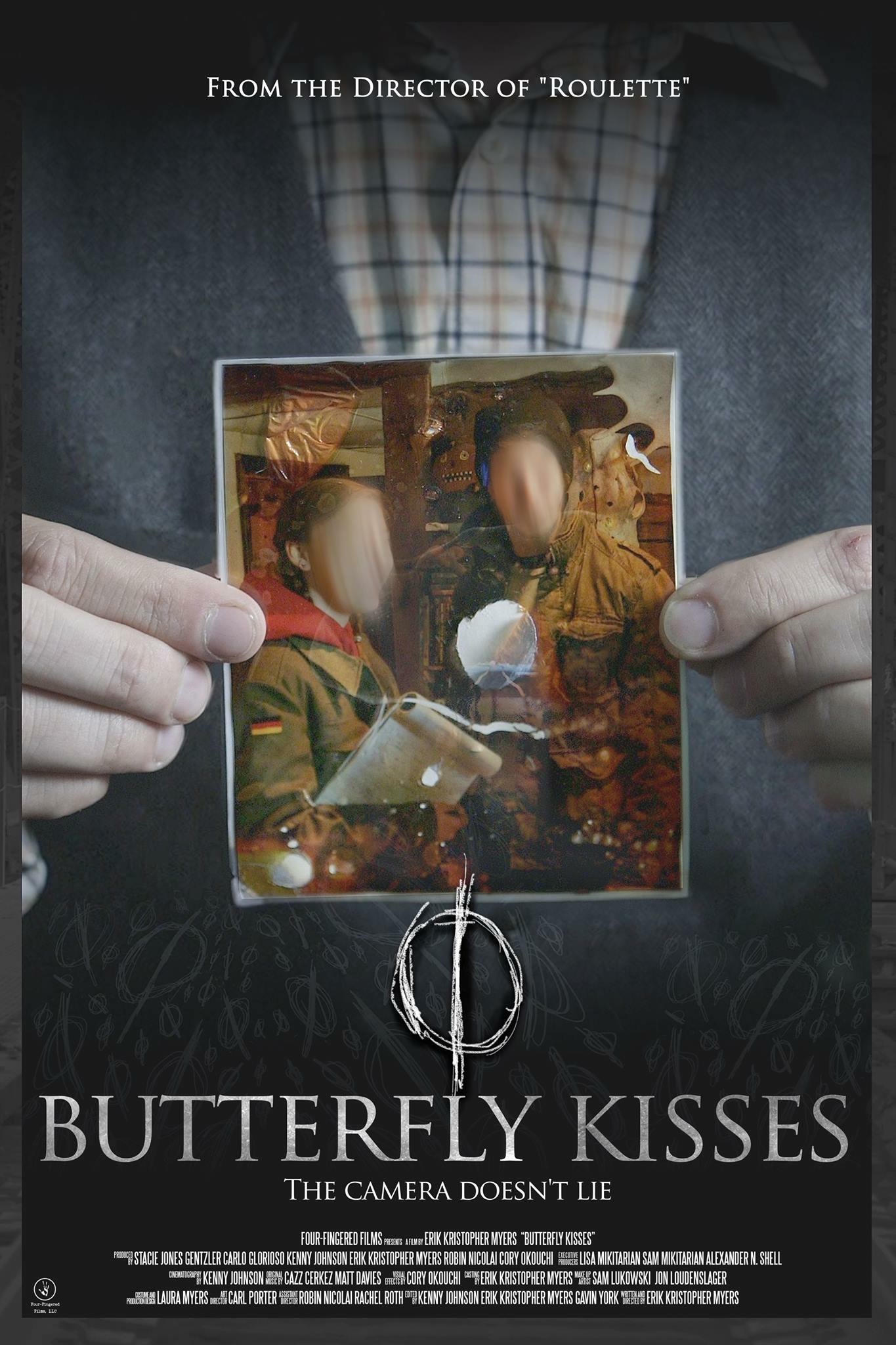
Butterfly Kisses is a found-footage film within a documentary within a documentary. It tells the story of a filmmaker, Gavin, who discovers a box of old films in the basement of his in-law’s home. No one really knows where the films came from, but when Gavin begins to watch them, he realizes they are the rough footage of a documentary some students shot about a local urban legend. The story goes that if you stare down a train tunnel for a full hour without blinking, a demon named Peeping Tom will appear in your distant vision. Why would that be the case? Who knows. Don’t think about it too much. But every time you blink, he gets closer…and closer…and closer. Until he’s right up on you and then…he gives you butterfly kisses.
OK, so that’s probably the dumbest, least frightening twist possible. But hear me out. This is a good movie. It’s not Lake Mungogood, which may be my favorite of this type of found-footage film. But it is consistently engaging, with a plot that sucks you in. The acting is great, the movie in a movie in a movie setup works. Does it sorta sputter to an end? Do people do really dumb things? Does the central conceit violate the rules set up in the beginning? Yeah, and that’s why it’s not a perfect movie. But it’s one you’ll enjoy and one you’ll think about well after the final credits roll.
When Jordan Peele’s Get Out hit theaters, it was a
revelation. A film that was equal parts horrifying and hilarious, Get Out was also the latest in a long
line of horror movies that addressed the shortcomings of our society. It’s hard
to think of a movie that more trenchantly tackled the racism that still exists
today, particularly prejudices that aren’t as pronounced or overt as in decades
past. I loved Get Out unreservedly,
and I could not wait to see Us. Although
not as impactful as Get Out, Us confirms Peele’s place as the most exciting
director in the genre today.
Get Out was a pretty strange movie at times;
Us is insane. It’s difficult to
describe the storyline without giving too much away, so I’ll keep it simple. A
family goes on vacation to a seaside town where the main character had a
disturbing encounter when she was a very young girl. Then another family shows
up in their driveway, and everything goes to hell.
Us is one of those movies where you
shouldn’t necessarily turn off your brain, but you also shouldn’t think too
deeply about what is going on. This is fairytale level crazy, and when you’re
reading a fairytale, you don’t ask too many questions about why the animals can
talk or where the fairy godmother gets her powers. Same here. The movie is at
its weakest when it tells too much, and I would have been happier with less
exposition. But that’s a minor gripe, and it’s one that is overcome by the shear
freakiness of the movie.
Us is deeply unsettling. It hits at something fundamental, something at the core of your being. It plays in places that most horror movies do not go, and it does it while maintaining a sinister tone of dread, lightened in all the right places with Peele’s trademark humor.
I’m sure Us has deeper meaning, but I’ll let other people worry about that. I enjoyed Us for what it was. You will too.
Sometimes you just want a movie that does what it does and
does it well. Overlord is one of
those movies.
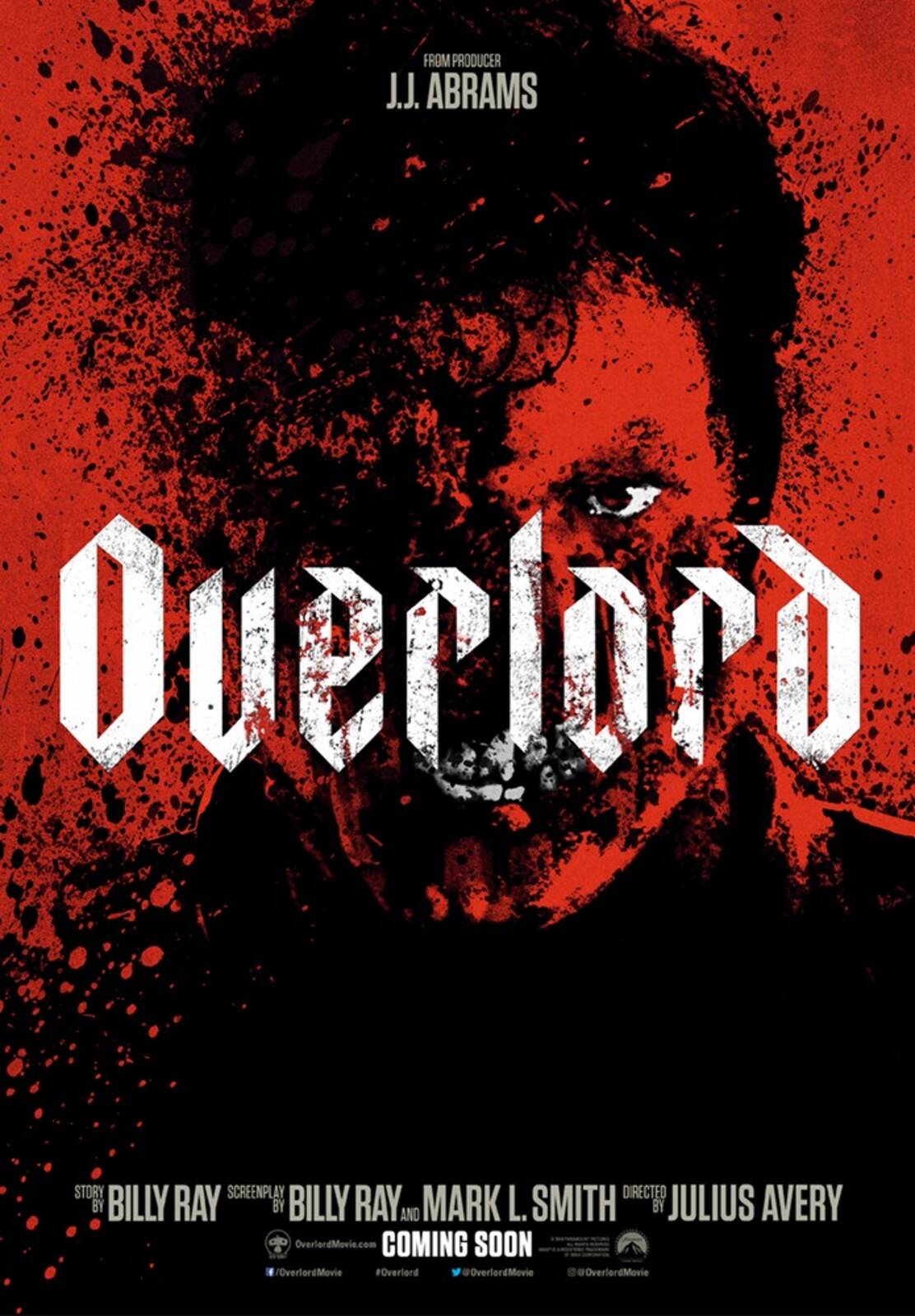
Overlord begins the day before the invasion of Nazi Germany by the Allied Expeditionary Forces. Our heroes are members of the 101st Airborne, and they’re on a plane ready to jump behind enemy territory to prepare the ground for invasion. They must destroy a radio tower, and if they don’t, the allied air force will be unable to take control of the skies. But when the team reach their target, they find a Nazi lab bent on building super soldiers who will win the war for Germany—whatever the cost.
Overlord is tense from the word go, setting the stage for what is to come by a thrilling segment where allied planes are maneuvering through enemy flack so thick you can’t believe any of them can make it. When the team reaches the ground, the tension doesn’t let up. The SS soldiers who are running the research station—and providing unwilling test subjects from the local populace—make delightfully unambiguously evil villains. Being unambiguously evil is the only thing Nazis are good for, and the filmmakers use them to full effect.
Overlord is far from a perfect movie. If you let yourself think about it for too long—more than a couple minutes, actually—you’ll note some glaring anachronisms and some plot threads that are never tied together. Still, this is a solid horror flick, good for more than a few scares. Well worth the viewing.
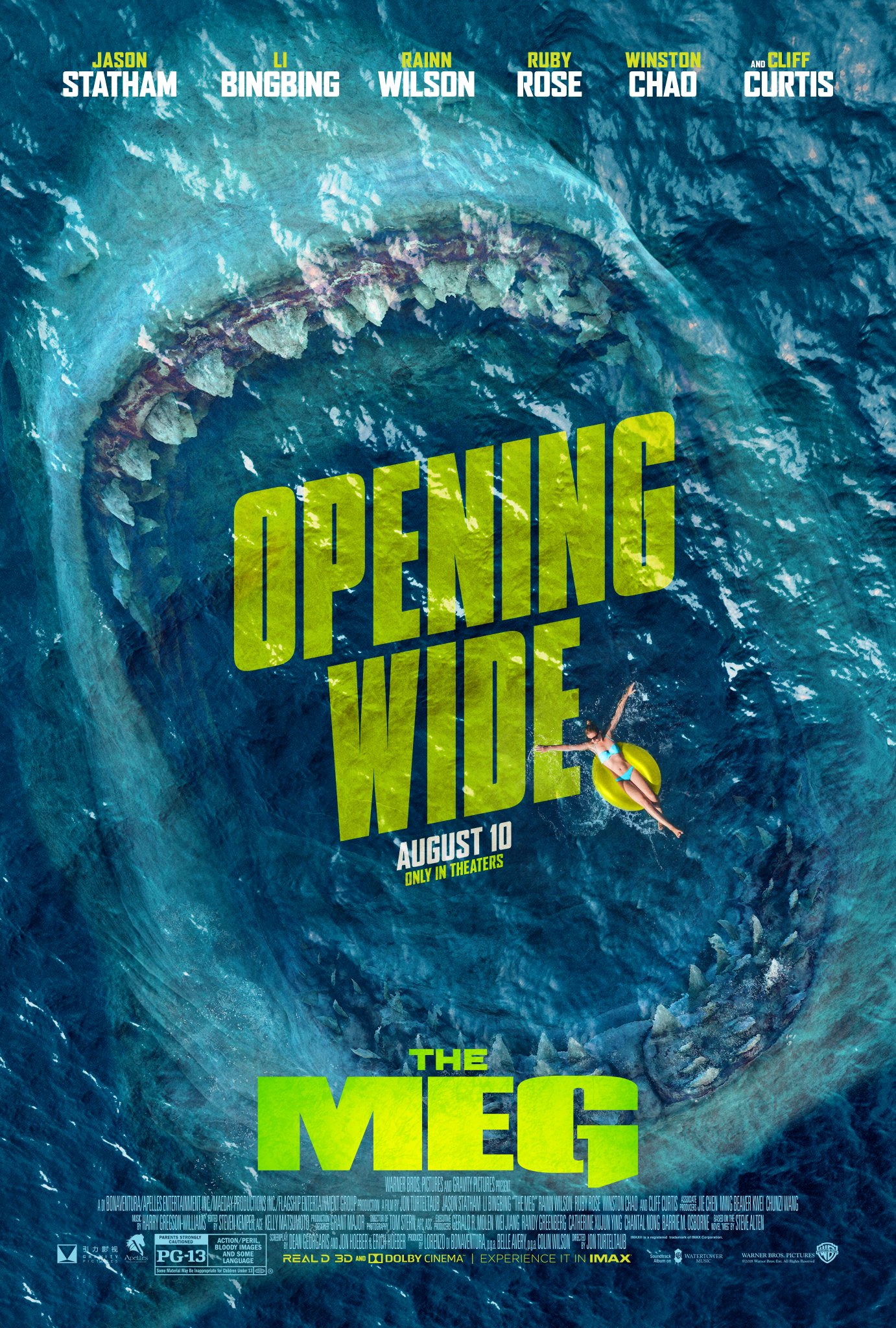
We’re in the midst of a horror renaissance, and in the last several years, dozens of new classics of the genre have hit theaters. With so many to pick from, I recently decided to choose…The Meg.
People love a good shark movie. Jaws is a classic. Deep Blue Sea isn’t perfect, but it has some incredible moments. And there’s always Sharknado. I-V. Meg won’t be joining that list.
Jonas (I wish they’d just gone full own and called him Jonah) is a rescue diver who experienced something he couldn’t explain in a deep-sea dive to save the crew of a submarine. He lost two members of his team, and for the last five years, he’s lived in self-imposed exile in Thailand, drinking Chang beer and pretty much having a good time wallowing in his own misery. He’s supposed to be washed up and tortured, but Jason Statham plays the character like he plays all his roles—tough guy with the heart of gold, quick with a one-liner and always willing to save the day. When a deep sea research team, led by his ex-wife, experiences trouble exploring a heretofore unknown part of the ocean, he rides in to save the day. This is much to the chagrin of the doctor on the research station, the same doctor who declared him unfit to dive after the last tragedy. Oh, and the doctor also happened to be on the submarine Jonas saved five years before. The coincidences are just amazing. Anyway, the research group is led by a father and daughter team, and the billionaire who finances their research. When it becomes clear that a megalodon is on the loose, they must figure out a way to stop it.
There’s a lot going on in Meg, too much. The doctor storyline plays out pretty quickly and seems unnecessary. As does the ex-wife storyline. You might expect them to get back together, but the whole notion of these two ever having been a couple in the first place is utterly implausible. Instead, Jonas is interested in the daughter of the father-daughter team. They have no chemistry, whatsoever. Meanwhile, most of the tension is generated by people doing really, really dumb things. How many times do people have to fall off the back of a boat before they stop standing on the edge of it, or, I don’t know, holding on? And man, does this movie drag on. It’s at least twenty minutes longer than it should be. At least.
Meg works best, when it works at all, as a comedy. If it embraced it fully, it would probably be at least arguably worth your time. But it doesn’t, and it’s clear the actors don’t take it all that seriously. Or at least, I hope they don’t take it seriously. Otherwise, I fear for their careers.
Here’s the thing—if you love shark movies, need to see them all, and you have absolutely nothing else to do with your time, Meg is moderately entertaining. Moderately.
I promise not to spam you, and I'll never give away your information. This is only for BIG announcements like new book releases or Pulitzer prizes won. That sort of thing. Click the book to sign up!




 Beware The Shadows