Many of you will recognize this song as the theme from Civilization 4. Others of you might know it as the first video game theme to win a Grammy. In reality, it’s the Lord’s Prayer . . . in Swahili. Enjoy.
Many of you will recognize this song as the theme from Civilization 4. Others of you might know it as the first video game theme to win a Grammy. In reality, it’s the Lord’s Prayer . . . in Swahili. Enjoy.
Filed under Music
Now, I am not saying that I can write anything like Kurt Vonnegut; I can’t. But people always ask me how I write, and this pretty much nails it.
It’s like making a movie: All sorts of accidental things will happen after you’ve set up the cameras. So you get lucky. Something will happen at the edge of the set and perhaps you start to go with that; you get some footage of that. You come into it accidentally. You set the story in motion and as you’re watching this thing begin, all these opportunities will show up. So, in order to exploit one thing or another, you may have to do research. You may have to find out more about Chinese immigrants, or you may have to find out about Halley’s Comet, or whatever, where you didn’t realize that you were going to have Chinese or Halley’s Comet in the story. So you do research on that, and it implies more, and the deeper you get into the story, the more it implies, the more suggestions it makes on the plot. Toward the end, the ending becomes inevitable.
—Kurt Vonnegut, November 1985
Filed under Tips for Authors
If you are a Goodreads member, you can enter now to win one of ten copies of my next book, The Void! Exciting, right? Here’s the link for your clicking pleasure.
Filed under News
Check out my 5 Star review of J.G. Faherty’s Cemetery Club in the review section. Great book.
Filed under My Reviews
Filed under News
 She sat alone on a wide sandy beach that Friday the 13th, nothing but her chair and an umbrella to remind the world that mankind lived upon it. There wasn’t a cloud in the great blue sky and not a bird or beast to be seen for miles. A shadow passed over her.
THE END
Filed under Short Stories
Don’t know how any kid from the 90s can’t love this song. It is so perfectly filled with nostalgia that it makes me want to cry.
Filed under Music
On Monday, the new Publishers Weekly will drop, and guess whose book is on the cover? That would be mine (honored to share the cover with J.G. Faherty and Jeffrey Wilson). For most of you, this will be your first look at the cover of the new book! Not to be forgotten, That Which Should Not Be is chilling on the back cover. And oh yeah, my studly good looks will greet you when you open the magazine. Do you really need more of a reason to buy one?

I didn’t think so.
Filed under News
Johnny Depp, aka spoiler pirate.
Arrr! There be spoilers ahead!
Yesterday I discussed how traditional good vs. evil struggles are not absent from Lovecraft’s fiction. Today I want to get to the point—the presence of religion in That Which Should Not Be. The best way to do that is to discuss what I was trying to accomplish in this crazy book.
For whatever reason, some people just could not handle the mention of anything religious in relation to the Cthulhu mythos. The funny thing is, there’s not that much in TWSNB. Sure, there are several references to the Bible, but almost all of those are reinterpreted as referencing the Great Old Ones. I mean, if that guy on the History channel can see aliens in every verse of the Bible, why not Cthulhu in Revelations?
Yeah, this guy.
In fact, I think there are only three overt references to Judeo-Christianity in the TWSNB. The first and second are actually the same—Jack’s use of a cruciform to defeat the Wendigo and Weston’s subsequent use of that weakness to fend off Thayerson towards the end of the novel. The last is Captain Gray’s use of the name of God in a spell. Now, I have no problem if you want to read that as a straight Christian allegory. I’m a Christian, and Christian themes have been present in literature in every form for the last 2000 years. But the thing is, such a simplistic reading sorta misses the point.
As is stated multiple times in TWSNB, one of the driving principles of the book is that there is truth in every legend, every myth. Take the cross, for instance. Lovecraft scholars who objected to the power of the cruciform might be shocked to learn this fact, but the cross as a holy symbol predates Christianity and indeed is present in nearly every culture. (Hence the reference in TWSNB to the ankh). Indeed, the ankh of ancient Egypt was the ultimate symbol of life. We see the cross in Eastern and Aryan religions, and archeologists regularly find Bronze Age objects (and even bones) engraved with the cross. Lovecraft talks about certain signs and sigils that were used to keep the Old Ones at bay. Why not a cross? That Jake stumbled upon this defense because of his Christian faith doesn’t mean my book is the equivalent of Left Behind: The Cthulhu Stories.
I mean, is there anything this guy could tell you that you wouldn’t believe?
Finally, the name of God. The use of the name of God as an instrument of power isn’t from the Christian tradition, at least not in the way I used it. It’s Kabbalistic mysticism. According to some strands of Kabballah, it was the name of God that was used to create the world. What a powerful word THAT must be. What better way to bind Cthulhu? (And let’s recall, SOMETHING put Cthulhu and the Old Ones in their place. Whether it was the Christian God or not, it was something pretty powerful.)
In reality, I knew that there would be some in the Lovecraft community who would reject the book as an insult to Lovecraft. There’s nothing I can do about that. But when people like Mike Davis over at the Lovecraft eZine give the book the praise they do, I know that it was worth the slings and arrows. And hey, there’ve been a lot more good reviews than bad ones.
Filed under Humor, Literary Musings, Uncategorized

Come on! Can you say no to those eyes?
I try and avoid blatant self-promotion, but I’m in this Goodreads blog contest, and I really need your vote! We aren’t as big as a lot of the blogs we are up against, so it’s going to take every vote we can get. All you have to do is click. . .
Filed under Contests
I am constantly amazed at what people can do with a computer.
Apologies for the multiple posts today, but you don’t want to miss this. Frank Grace created this image. He writes:
April 1st, 2012: I attended a really intense gathering to celebrate the literary legacy of a master writer of horror fiction. The annual H.P. Lovecraft Service of Tribute took place on Sunday, April 1, 2012 on the front ground of Ladd Observatory, built in 1891 and frequented by H.P. Lovecraft in his boyhood years. With this occasion the crowd, led by Carl Johnson, commemorated the 75th anniversary of the author’s untimely passing.
Thanks Carl for letting me know about the event. I am glad I went. I found the weather perfect for the event.
Be sure to check out Frank’s website: Trig Photography. He has some incredible images!
Filed under Uncategorized
NB: There are spoilers galore in the below post.
 I often admonish writers to avoid the temptation of responding to negative reviews. Nothing good can come of it. People like what they like, and reviewing is perhaps the most subjective business of all time. But I’ve noticed an interesting trend in reviews of That Which Should Not Be (both positive and negative), and I wanted to address it. This is the first in a series of posts I plan to make on the issue.
There’s been a diverse reaction to the presence and role of religion in TWSNB. In Lovecraft’s writing, the Cthulhu mythos is a sort of forbidden knowledge, studied by certain scholars but largely unknown. And while Lovecraft often discusses the ancient gods in relation to the mythos, he rarely discusses the Judeo-Christian tradition. Probably a good idea, given the times he lived in. The people of the 20s and 30s might not have taken too kindly to any implications that could be drawn from it.
It’s also important to remember that Lovecraft didn’t think of what we now call the Cthulhu Mythos as a religious tradition unto itself. The pantheon of the Old Ones, as we now consider it, was never so well ordered by Lovecraft. Much of what people now defend as Lovecraftian is, in reality, a creation of those who followed him. The major contribution of Lovecraft is not the notion of a hitherto undiscovered or unknown set of gods seeking to wreak havoc on humanity. Rather, it is the notion of cosmic indifference. The universe is vast, in many ways unknowable, prone to chaos, and completely uncaring about the fate of mankind. That great beings exist is simple fact.
Many Lovecraft scholars argue that this goes one step further. They argue that the Great Old Ones are as concerned about humanity as we might be an ant hill. Much of the horror Lovecraft created came from his protagonists’ realization of this fact, and the insanity and hopelessness that followed from that. Once the truth was revealed to them, there was no purpose to continuing to live and suicide often followed.
I don’t deny that one can draw this conclusion, but I reject any notion that Lovecraft did not recognize the age old struggle between good and evil in his writing, or the role that humanity might play in that struggle. It seems to me that Lovecraft was never entirely consistent in his view of the relation between cosmic entities and humanity. I think a lot of Lovecraftians want to believe certain things about the mythos and are willing to ignore contradictory evidence. (In my view, S.T. Joshi, the greatest living Lovecraftian scholar, falls into this trap with The Dunwich Horror. I’ll discuss it in more detail below. Widely cited as one of Lovecraft’s greatest and most important stories, Joshi considers Dunwhich “an aesthetic mistake on Lovecraft’s part.”). In reality, Lovecraft was far less concerned with continuity across stories as he was in simply spinning a great yarn.
Frankly, story after story of hopeless humanity would probably get boring at some point. In Lovecraft’s greatest stories, humanity is not only noticed by the Old Ones, but they do a pretty good job of keeping them at bay. The fact that the Cthulhu cult exists and seeks to wake the Great Old One speaks to their need for human action, as do the consequences of Captain Johansen’s decision to ram the eponymous creature with his ship.
But The Dunwich Horror puts the lie to any notion that humanity has no role in Lovecraft’s cosmic play. In many ways, The Dunwich Horror is the centerpiece of the Cthulhu Mythos, even more so than the short story that bears his name. In Dunwich, we are treated to extensive quotations from the Necronomicon as well as an Old One conspiracy that comes nigh on close to succeeding. And how, pray tell, is it stopped? By the efforts of Henry Armitage and his compatriots who, by using the ancient knowledge contained in arcane texts, defeat the son of Yog-Sothoth and prevent the return of the Old Ones. (It almost sounds like The Omen).
I don’t see how we can ignore the implications of The Dunwich Horror. Dunwich clearly refers to a “strange evil so vaguely threatening this planet” and sets up a dynamic where good people can and do oppose the rise of the Old Ones. S.T. Joshi may disapprove of Dunwich because it is a “stock good-versus-evil scenario,” but that does nothing to diminish the importance of The Dunwich Horror to Lovecraft and the mythos. I take no issue with writers who have constructed stories based on Lovecraft’s view of cosmic indifference, but I also believe that the notion that you cannot have good and evil vying against each other in a Lovecraftian story is a product more of what the readers wish Lovecraft had done rather than what he actually did.
To be continued in a future post…
Filed under Literary Musings
Here are a few pictures from the World Horror Convention last weekend in Salt Lake City, Utah. I didn’t take nearly enough, but these will at least give you an idea of the goings on there.

Here I am wearing my Lovecraft eZine t-shirt with a hearse someone turned into their own personal vehicle. The Arkham license plate really seals the deal.

My publisher, Christopher Payne, is nothing if not persistent. He annoyed at least twenty people into buying a copy of The Void. Yes, that is an advanced copy of my next book sitting on the right edge of the table . . .
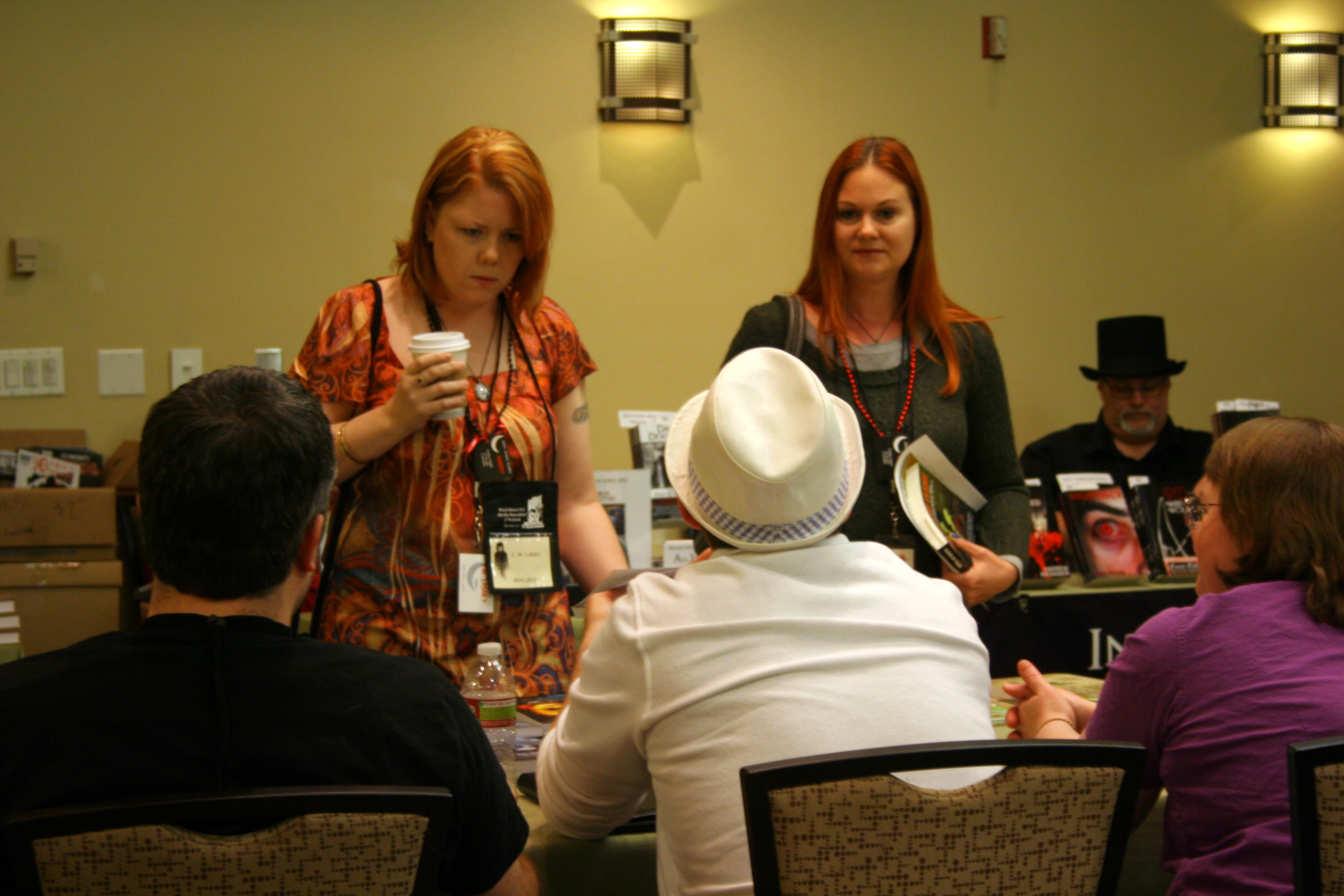
And here we are making the magic happen. Love the hat.

There she is! The final version will have a new cover, but that’s not coming out until the summer.

Here I am at the autograph session (note the pen) with Linda Addison, three-time Bram Stoker Award winner and all around literary genius. Buy her stuff, be amazed.
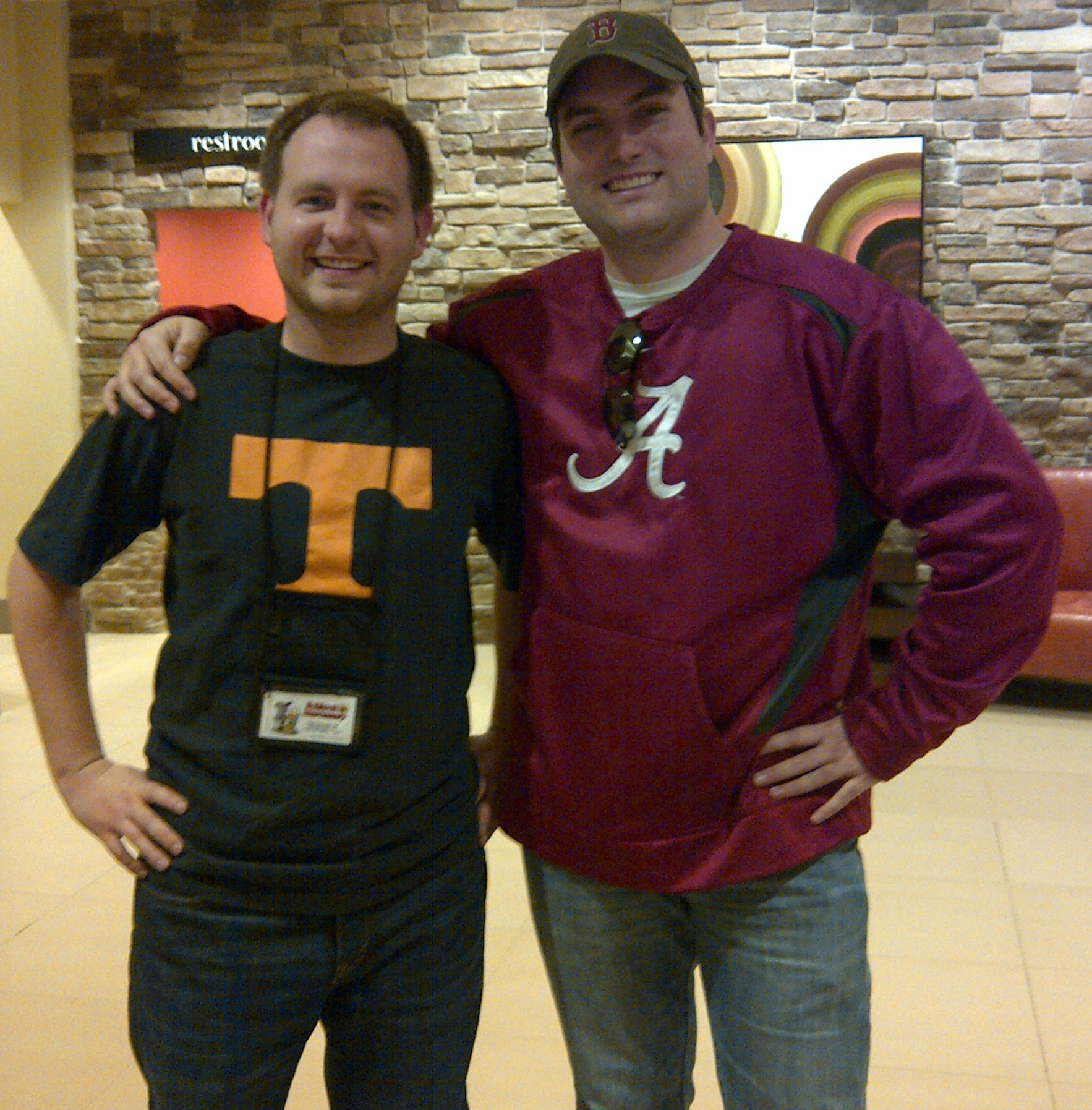
And finally, my favorite Tennessee fan, Brad Carpenter. Brad is finishing up his first novel. You’ll be hearing a lot about him soon.

I promise not to spam you, and I'll never give away your information. This is only for BIG announcements like new book releases or Pulitzer prizes won. That sort of thing. Click the book to sign up!




 Beware The Shadows